Carbon Footprint and Reporting

As the nation’s largest privately owned freight carrier, we take our environmental responsibility seriously. That means at Estes we’re not just tracking carbon emissions — we’re transforming how we operate. From investing in route optimization and top-tier equipment to reducing fuel consumption and advancing emissions reporting, we’re taking measurable steps to lower our Scope 1, 2, and 3 emissions.

And with measurable decarbonization goals guiding our efforts, we’re proud of our commitment to helping build a more efficient, sustainable supply chain — one mile at a time.

From regulatory requirements to customer expectations, carbon emissions reporting is becoming an essential part of doing business across the country and around the world.

That's why Estes provides accurate, shipment-level emissions data to help you confidently measure, report, and better understand your supply chain’s carbon footprint.

Developed in collaboration with SMC³ and aligned with the Smart Freight Centre's Global Logistics Emissions Council (GLEC) framework, Estes' Allocated Emissions Reporting Program (AERP) gives you detailed carbon emissions data for every shipment, including linehaul, pickup and delivery, Well-to-Wheel, and empty miles.

With this level of detail, you can confidently meet Scope 3 reporting requirements, track progress toward your sustainability goals, and identify opportunities to reduce your carbon emissions.

Upon request, our carbon emissions reporting is available to customers on a quarterly or annual basis. To get started, email sustainability@estes-express.com.

An Industry Standard You Can Trust

When reporting LTL carbon emissions, accurate data and standardized methodology matter.

Because LTL shipments share trailer space and are often cross-docked and co-loaded as they move through multiple terminals to reach their destination, calculating shipment-level emissions is far more complex than simply measuring miles traveled.

That's why Estes and other LTL carriers partnered with SMC³, a leader in LTL freight transportation technology solutions, to develop a standardized emissions calculator and internationally recognized reporting methodology that account for the complexities of LTL shipping.

By leveraging EPA SmartWay methodologies and aligning with the Smart Freight Centre's GLEC Framework, the SMC³ calculator allocates emissions at the shipment level based on actual transportation activity — providing consistent, transparent, and credible reporting across the supply chain.

Advancing Greener Trucking

At Estes, sustainability isn’t driven by short-term regulatory swings — it's built into how we operate, support our people, and provide reliable service every day. We take pride in staying ahead of regulatory requirements and providing our customers with the carbon emissions data and insights they need to make informed decisions that help drive greener trucking forward.

Since 2023, Estes has measured and reported our annual carbon footprint in our Sustainability Report. Working with Watershed, our sustainability platform provider, we capture direct and indirect emissions data from our operations across Scopes 1, 2, and 3. Annual reporting allows us to make more informed, strategic decisions as we work toward lowering our emissions.

Through this data-driven approach, we’re able to:

  • Analyze our emissions data with greater precision
  • Identify emissions reduction opportunities across our operations
  • Track progress and adjust strategies over time
  • Better manage our environmental impact

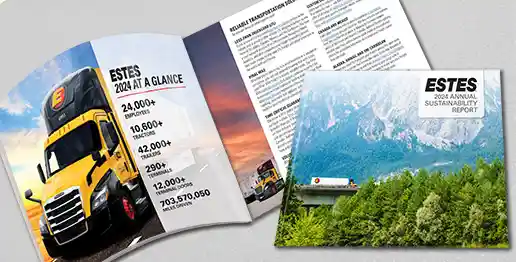
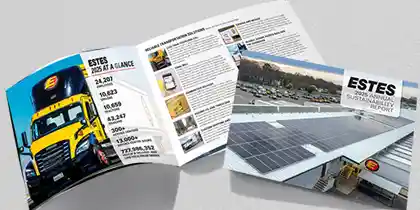
Explore the full footprint and what it means for our sustainability journey in our 2025 Sustainability Report.

Estes is making strategic investments and operational improvements to lower our carbon emissions through:

Route Optimization: Optym’s advanced route optimization tools help us streamline delivery schedules, reduce total mileage, and boost load efficiency—reducing fuel consumption

Equipment Performance: We maintain a high-performing fleet through top-tier equipment and proactive maintenance, helping reduce fuel consumption and carbon emissions while maximizing efficiency

Driver Efficiency: Samsara technology within our tractors monitors driver behavior and encourages fuel-smart habits. This telematics data allows us to assess vehicle performance through programs like the Driver Efficiency Score (DES), which measures environmental impact while empowering drivers to improve efficiency. These insights help advance driver and operational improvements while reducing fuel consumption and emissions. Since the programs mid-2024 launch, 2025 DES scores increased by nearly 3% per period, with gains across all four program categories: coasting, cruise control, idling, and RPM (green band)

Training: We provide our drivers with hands-on training in sustainability-focused techniques like proper tire inflation, optimal shifting, speed control, and reduced idling—turning everyday habits into long-term environmental gains